Temporary auth hash for RTSP stream from SDK
Completed
Hi
How could we get auth_digest from SDK without entering any login and password?
Do you have some functionality?
Thank you
-

Hi Oleg,
login/password values are used to generate auth_digest, you can't generate it without these credentials.
could you please give more details about your project? What kind of integration are you building? Is it metadata analytic plugin or integration with external services via API?
0 -
Hi Anton,
our project is Incoresoft VEZHA. We are looking for posibilyty to add stream directly to our system without any additional actions.
0 -
Allowing to access camera stream directly without any authorization in place wouldn't be secure. You'll need to be able to generate proper authorization from your system.
I think this article would be helpful for you. It provides code sample example on how to generate auth_digest. You can use similar approach to generate rtsp/http urls for your external system.
0 -
Dear Anton,
I have written you that we are using your SDK(it's C++ SDK). User are logged in your VMS system and he enter the login and password. You are telling me that its not secure to generate auth token without authorization, but we had authorization. You send me the article with JS code and recomend me to send from your native SDK HTTP request to the same system and generate auth token. I dont understand it.
Thank you
0 -
Sorry, but it's not clear to me on that you're trying to achieve.
You send me the article with JS code and recomend me to send from your native SDK HTTP request to the same system and generate auth token. I dont understand it.
As of now, SDK doesn't provide tools to use mediaserver's API. We're considering to implement this feature in future releases, but for now, the only way is to send HTTP queries with proper authorization as any external client would do.
We are looking for posibilyty to add stream directly to our system without any additional actions.
Could you please clarify use-case scenario on this? At this point it isn't clear to me why would you need auth hash for rtsp stream. Are you developing analytic plugin based on metadataSDK or something else? We also have storageSDK and cameraSDK.
0 -
Wre are developing analytic plugin based on metadataSDK. We dont want to ask user authorization info, because its not natively.
0 -
In that case, I'm not following your question regarding how to get RTSP stream.
I'm assuming you want to know how to receive/process video frames from mediaserver inside your plugin. If that's the case, you don't need auth_digest or any other credentials. As soon as mediaserver receives new frame via RTSP from the camera, it pushes it to the plugin by calling function pushCompressedFrame() and pushUncompressedVideoFrame(). All you'll need to do is to specify video frame pixel format in plugin manifest and implement function pushUncompressedVideoFrame()/pushCompressedFrame() in your plugin. You can check this article explaining plugin control flow.
If that's not what you're asking, please describe step by step on what you're trying to implement.
0 -
Its not good for our solution - we are trying to send RTSP stream directly to our system without entering any additional authorization data in VMS. We don't want to send and save login and password to our system in RTSP URL, because its not secure. For us better to receive some RTSP url with auth token and save it in our system. Our video analytic solution is failover and we working with different analytics servers and we fully processing and decoding streams on our side.
If we are talking about pushCompressedFrame - its not comfortable for us .
If we are talking about pushUncompressedVideoFrame - its bad for network.
0 -
For us better to receive some RTSP url with auth token and save it in our system.
I see, but how would you handle token renewal on your end? Each auth token has expiration time. You can generate link with temporary auth at https://<mediaserver IP>:7001/static/index.html#/view/ in web admin interface:
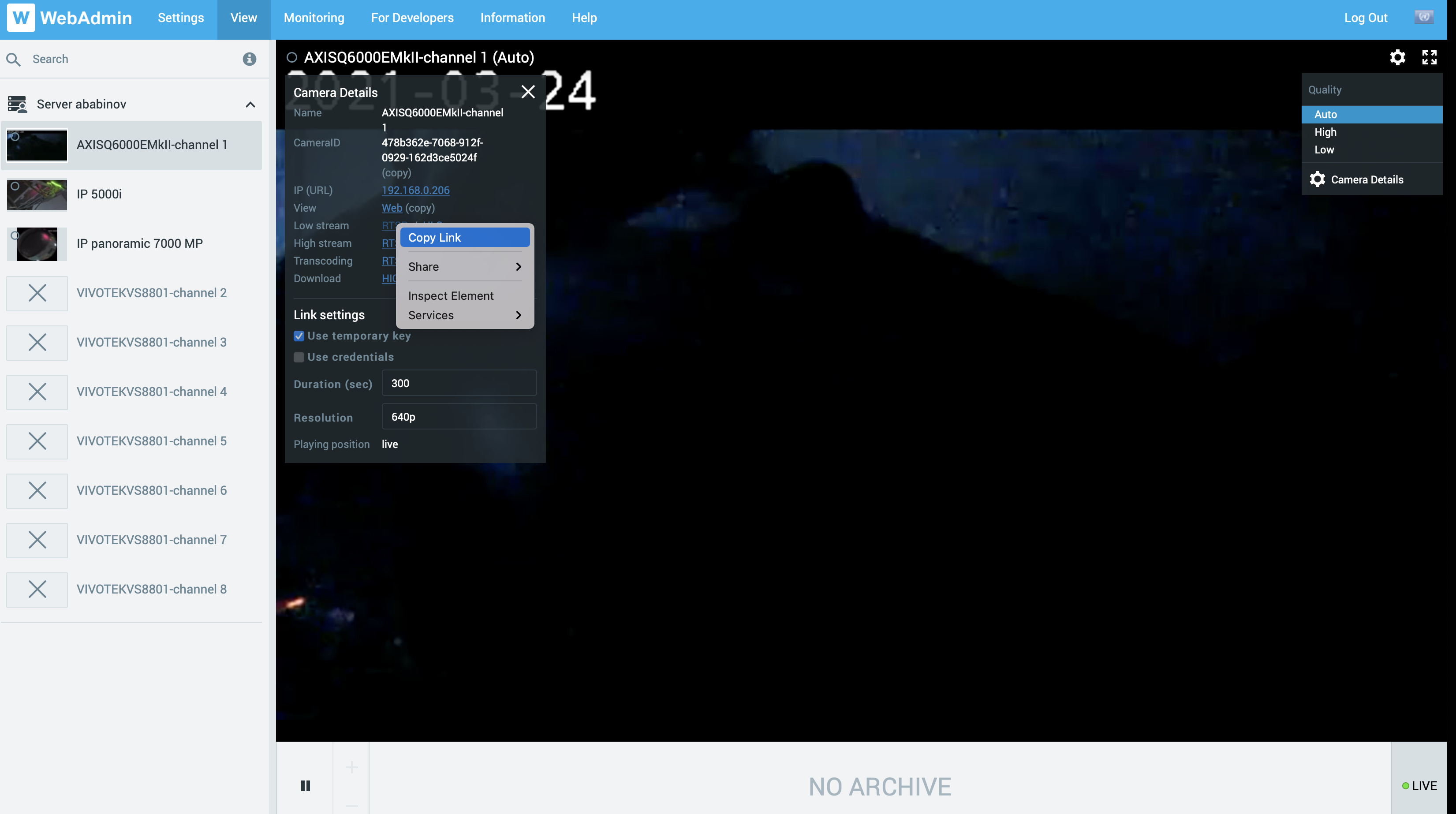
This link will be valid for as long as session is active and will expire after ~30 minutes of inactivity.
0
Please sign in to leave a comment.
Comments
9 comments